
Cooling solutions
Hydro-Cooled Miner Hosting
Purpose-built liquid loops for hydro-series miners that need direct water cooling to run at full rated performance.
How it works
Closed-loop coolant distribution
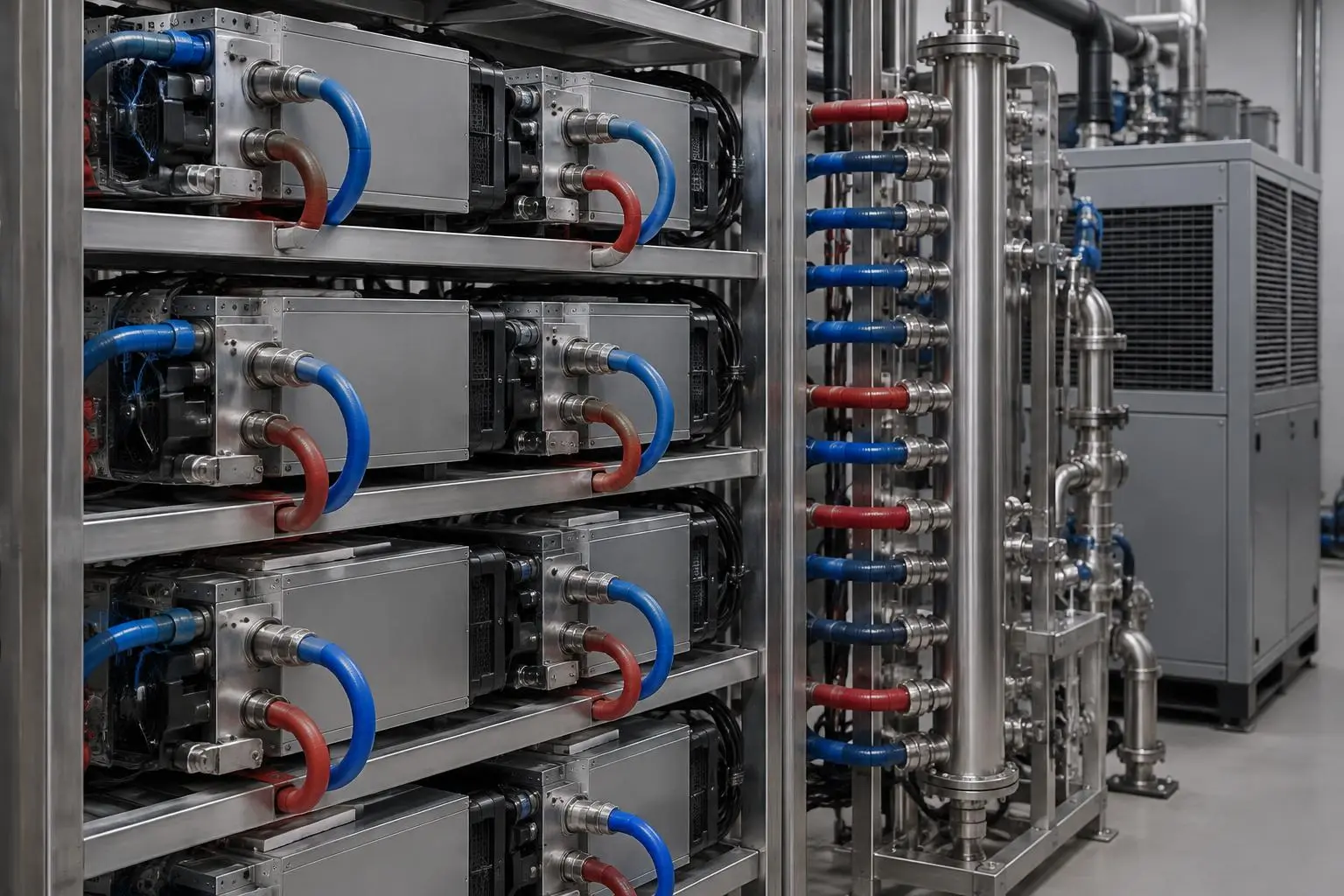
Hydro miners have cold plates attached directly to their hashboards. Coolant is pumped from a coolant distribution unit through manifolds to each miner, absorbs heat, and returns to heat exchangers or dry coolers outside.
Because heat is carried by liquid rather than air, hydro miners operate quietly with very stable chip temperatures.
- Coolant distribution units (CDUs)
- Supply and return manifolds
- Heat exchangers and dry coolers
- Flow, pressure and temperature monitoring
Why hydro cooling
High density
More hashrate per square metre than air cooling.
Stable temperatures
Consistent chip temperatures regardless of weather.
Quiet operation
No high-speed miner fans required.
How the coolant loop moves heat out of a hydro miner
Hydro cooling carries heat away from chips through liquid-cooled plates rather than immersing the entire miner. The exact plumbing depends on the equipment, but a typical installation follows this sequence. Some designs separate the miner coolant circuit from an outdoor heat-rejection circuit; others use a different arrangement approved for the hardware.
- 01
Condition the coolant entering the miners
The supply circuit delivers coolant within the miner manufacturer's permitted inlet-temperature, pressure, and chemistry limits. Cooler is not always better: coolant below the surrounding air's dew point can cause condensation on exposed surfaces. Setpoints must account for both hardware requirements and operating conditions, not just the lowest temperature the cooling equipment can produce.
- 02
Distribute flow through the supply manifold
Pumps create the pressure difference needed to circulate coolant, while a supply manifold divides flow among connected miners. Branch balancing matters because parallel circuits do not automatically receive equal flow. Hose length, fittings, restrictions, and cold-plate design influence how much coolant reaches each machine.
- 03
Absorb heat at the cold plates
Coolant passes through channels in plates thermally coupled to the chips. Heat conducts into the plates and then transfers to the moving liquid. Adequate flow limits the coolant's temperature rise, but excessive flow can exceed pressure limits or waste pumping energy. The manufacturer's operating envelope should guide both settings.
- 04
Collect the warmed return coolant
A return manifold collects heated coolant from the miner branches. Comparing supply and return temperatures helps explain heat pickup, especially when paired with flow measurements. A temperature difference alone cannot confirm healthy cooling: low flow can produce a large difference while allowing components to run too hot.
- 05
Transfer and reject the heat
Where separate circuits are used, a heat exchanger transfers heat without mixing their fluids. The external circuit then carries that heat to rejection equipment, such as dry coolers. Dry-cooler performance depends on outdoor air temperature and exchanger sizing; it cannot independently cool liquid below the entering air temperature.
- 06
Monitor conditions and repeat the cycle
The cooled fluid recirculates continuously while controls track temperatures, flow, pressure, and equipment status. Alarm logic should distinguish a single restricted branch from a wider pump or heat-rejection problem. Safe shutdown behavior matters because continued electrical operation without adequate coolant circulation can quickly threaten the hardware.
Hydro cooling components and their roles
These components work together as a system; selecting individual parts without checking hydraulic, thermal, and material compatibility can leave otherwise suitable miners inadequately cooled.
| Component | Role in the cooling system | What to verify |
|---|---|---|
| Pumps | Circulate coolant by overcoming resistance through cold plates, hoses, valves, and heat exchangers. | Required flow at the actual system pressure drop, compatible wetted materials, and behavior during a pump fault. |
| Manifolds | Split supply flow among miners and collect warmed coolant from their return branches. | Branch balancing, isolation valves, pressure ratings, and access for servicing one miner without unnecessarily disturbing others. |
| Coolant distribution units (CDUs) | Manage coolant delivery and, depending on design, integrate pumps, controls, filtration, and circuit isolation. | Supported temperatures, available pumping pressure, control interfaces, and whether an internal heat exchanger separates the circuits. |
| Heat exchangers | Move heat between fluid circuits while keeping the fluids physically separate. | Thermal capacity at intended operating temperatures, pressure drop, fouling allowance, and compatibility with each circuit's coolant. |
| Dry coolers | Use fans to move ambient air across finned coils and reject heat from the external coolant circuit. | Performance during hot weather, fan controls, coil cleanliness, and the external circuit's freeze-protection requirements. |
| Quick-disconnect couplings | Provide detachable coolant connections; suitable valved designs limit fluid release during disconnection. | Matching connector types, seal compatibility, pressure and temperature ratings, and whether connection or disconnection requires depressurization. |
| Sensors | Measure conditions such as supply temperature, return temperature, pressure, flow, and possible leakage. | Sensor placement, calibration, alarm thresholds, and whether protective controls act on missing or implausible readings. |
Hydro versus immersion: the practical differences
Both approaches use liquid to transport heat, but they require different hardware, fluids, and maintenance procedures; neither is automatically the better choice for every deployment.
| Decision point | Hydro cooling | Immersion cooling |
|---|---|---|
| Heat collection | Coolant flows through sealed cold plates attached to heat-producing components. | Electronic assemblies sit in a dielectric fluid that absorbs heat directly from exposed surfaces. |
| Fluid requirements | Uses manufacturer-specified coolant with controlled chemistry and material compatibility. | Requires dielectric fluid compatible with boards, cables, seals, and other submerged materials. |
| Hardware suitability | Purpose-built hydro models need matched flow, pressure, temperature, and connection specifications. | Equipment must be suitable for immersion; modifications can affect support and warranty eligibility. |
| Routine service | A miner may need branch isolation, controlled disconnection, and leak checks before returning to service. | Removal can involve draining fluid from equipment and handling fluid-wetted assemblies. |
| Infrastructure | Depends on plumbing distribution, circulation equipment, and suitable heat rejection. | Adds tanks and fluid-handling requirements alongside circulation and heat rejection; compare immersion cooling hosting considerations. |
Water quality and coolant maintenance
Treat coolant as an engineered consumable, not interchangeable water. The correct fluid depends on the miner, cold plates, seals, and other wetted materials. Manufacturer requirements may specify pH, conductivity, hardness, chloride limits, or approved corrosion inhibitors. Tap water can introduce minerals and contaminants, while untreated purified water is not automatically suitable for every mixed-metal system. Use the specified coolant formulation and documented water quality rather than choosing a fluid solely because it appears clean.
Establish a baseline when a circuit is commissioned, then follow a sampling schedule suited to the coolant supplier's guidance and operating conditions. Record relevant chemistry readings, fluid appearance, filter condition, and any additions. Compare results over time instead of treating a single acceptable sample as proof of long-term stability. Inhibited fluids may need checks for inhibitor depletion; glycol mixtures may need concentration testing. Glycol changes viscosity and heat-transfer performance, so adding more can affect pumping requirements and cooling capacity.
Maintenance should also address contamination sources and mechanical symptoms. Repeated topping up can signal a leak and introduce oxygen or dilute additives. Rising pressure drop may indicate a restricted filter or fouled passage, while unstable flow can point to trapped air or another hydraulic problem. Use compatible replacement fluids, avoid mixing products without approval, and follow documented flushing and venting procedures. After work, verify leak integrity, circulation, and stable operating temperatures before restoring the miner to its intended load.
Compatibility checks for S21 Hydro and M63S Hydro
The S21 Hydro and M63S Hydro are examples of hydro-cooled ASIC models to evaluate against a hosting system's technical requirements. A model name alone does not establish compatibility: confirm the exact variant, electrical input, connector specifications, coolant requirements, permitted inlet conditions, and required flow. Consult the supported miner information alongside current manufacturer documentation. Hardware revisions and operating profiles can change the requirements that determine whether a particular machine fits a proposed installation.
Electrical and cooling checks should happen together. A suitable coolant connection does not resolve an incompatible power supply, and sufficient electrical capacity does not establish adequate heat rejection. Before shipment, document the unit's condition, shipping preparation, included fittings, and any manufacturer-required draining procedure. Confirm responsibility for adapters and commissioning checks rather than assuming accessories are interchangeable. Hosting prices are quote-only; a useful quote identifies the exact miner and operating assumptions. Mining revenue is not guaranteed, even when cooling operates correctly.
FAQ
Common questions
Which miners are hydro-compatible?
Models designed for hydro cooling such as Antminer Hydro series and selected Whatsminer hydro models. Compatibility is confirmed per model.
Is hydro hosting more expensive?
Infrastructure costs differ by cooling type. Your quote will reflect your hardware and requirements.
Do you guarantee mining revenue?
No. We provide hosting infrastructure and services. Mining revenue depends on network difficulty, coin prices and hardware efficiency, which are outside our control.
Can hydro cooling cause condensation on a miner?
Yes. Condensation can form when exposed surfaces become colder than the surrounding air's dew point. This is why coolant temperature should not simply be set as low as possible. Appropriate inlet-temperature controls, humidity awareness, and insulation where required help manage the risk. The operating strategy must also stay within the miner manufacturer's specified temperature limits.
Can an air-cooled ASIC be converted to hydro cooling?
Some equipment may have aftermarket conversion options, but feasibility depends on the exact hardware and the quality of the conversion design. Cold-plate fit, component coverage, leak integrity, firmware behavior, and warranty implications all need review. A converted machine should not be assumed equivalent to a purpose-built hydro model or compatible with a hosting loop without technical approval.
Does hydro cooling always consume water continuously?
No. A closed coolant circuit recirculates fluid rather than intentionally consuming it on every pass. Overall water use depends on the heat-rejection equipment: dry coolers and evaporative systems have different requirements. Filling, maintenance, leaks, and fluid replacement can still require makeup fluid. Ask about the complete cooling arrangement, not only whether the miner itself uses water-based coolant.
Is coolant temperature difference enough to measure cooling performance?
No. Heat transfer depends on mass flow, coolant heat capacity, and the temperature difference between supply and return. A larger temperature difference may reflect reduced flow rather than improved performance. Useful assessment combines those measurements with chip temperatures, electrical load, and pressure data. Sensor accuracy and coolant composition also matter when estimating how much heat the loop carries.
Ready to Host Your ASIC Miners?
Share your equipment details and our team will prepare a customised hosting quotation.